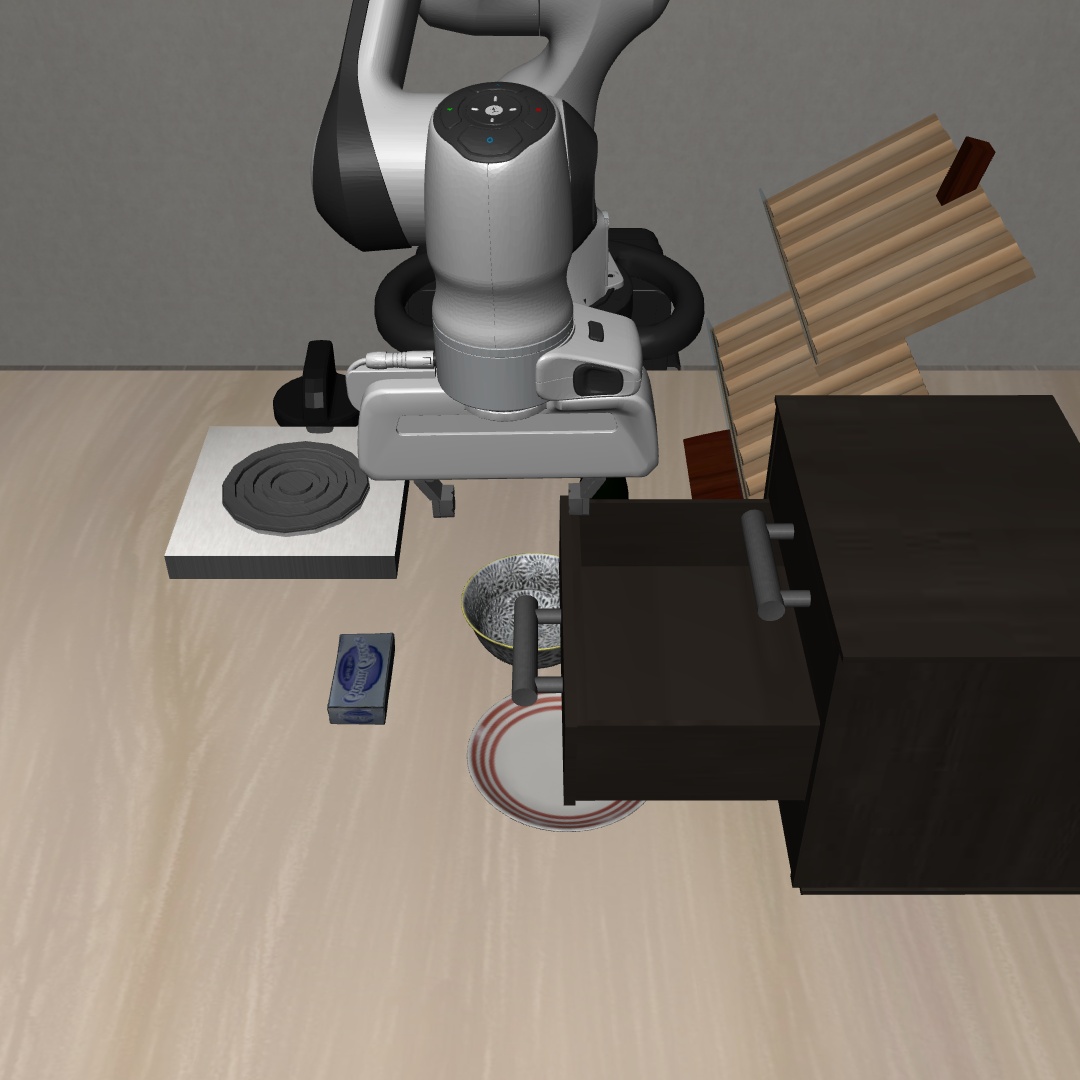
 1 · Body Reset (Home)
Composing frozen Vision-Language-Action (VLA) skills under an agentic planner promises scalable long-horizon manipulation without end-to-end demonstrations, yet strong atomic skills routinely fail at the seams between them even under a correct plan. Standard remedies either reset the robot's pose or draft entry conditions in language, missing the physical cause we uncover through controlled causal interventions: even after re-homing, a frozen VLA rigidly retraces its habitual trajectory and collides with displaced scene residue, whether or not the residue is visible.
We propose the 3D Skill Envelope, a policy-measured geometric precondition capturing the exact 3D volume a frozen skill
sweeps during its own solo successful executions. Because the rigidity that makes a frozen skill fragile at seams also makes its
trajectory predictable in advance, we expose each envelope as two classical 3D tools—CHECK to flag blocking residue before
execution and FREE to compute safe multi-step placements—establishing a clean division of labor where
VLAs execute in-distribution skills and code recovers out-of-distribution states. Across LIBERO-Goal
(π0.5) and BOSS-44 (BC-ViT-T), Skill Envelopes outperform frontier VLMs at seam prediction (0.902 vs. 0.793
AUROC), lift autonomous LLM composition from 84.0% to 91.4% on LIBERO and from 25.7% to 60.0% on
BOSS-44, and deliver a 5.60× speedup under live single-view RGB-D gating.
Part I · Controlled Causal Diagnosis
Done ≠ Ready: Seam Failures Are Physical Collisions, Not Visual Distraction
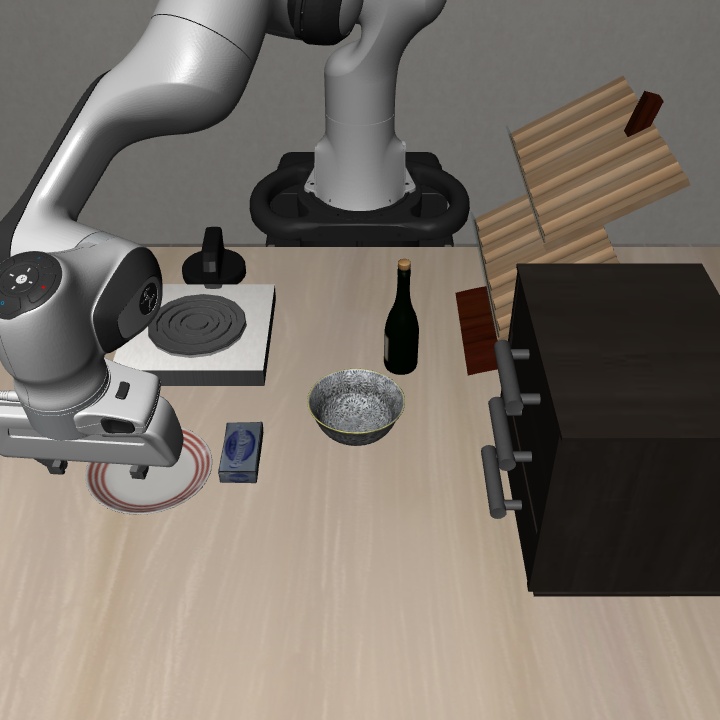
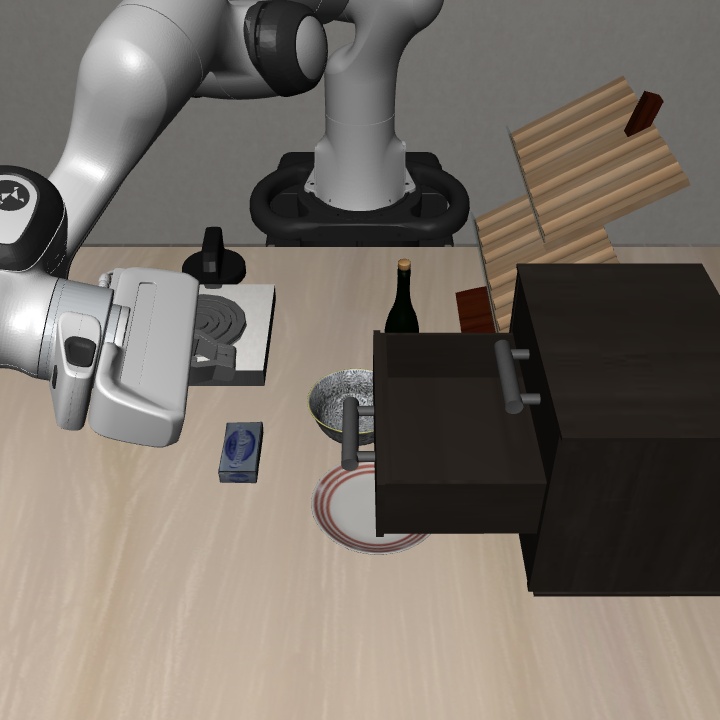
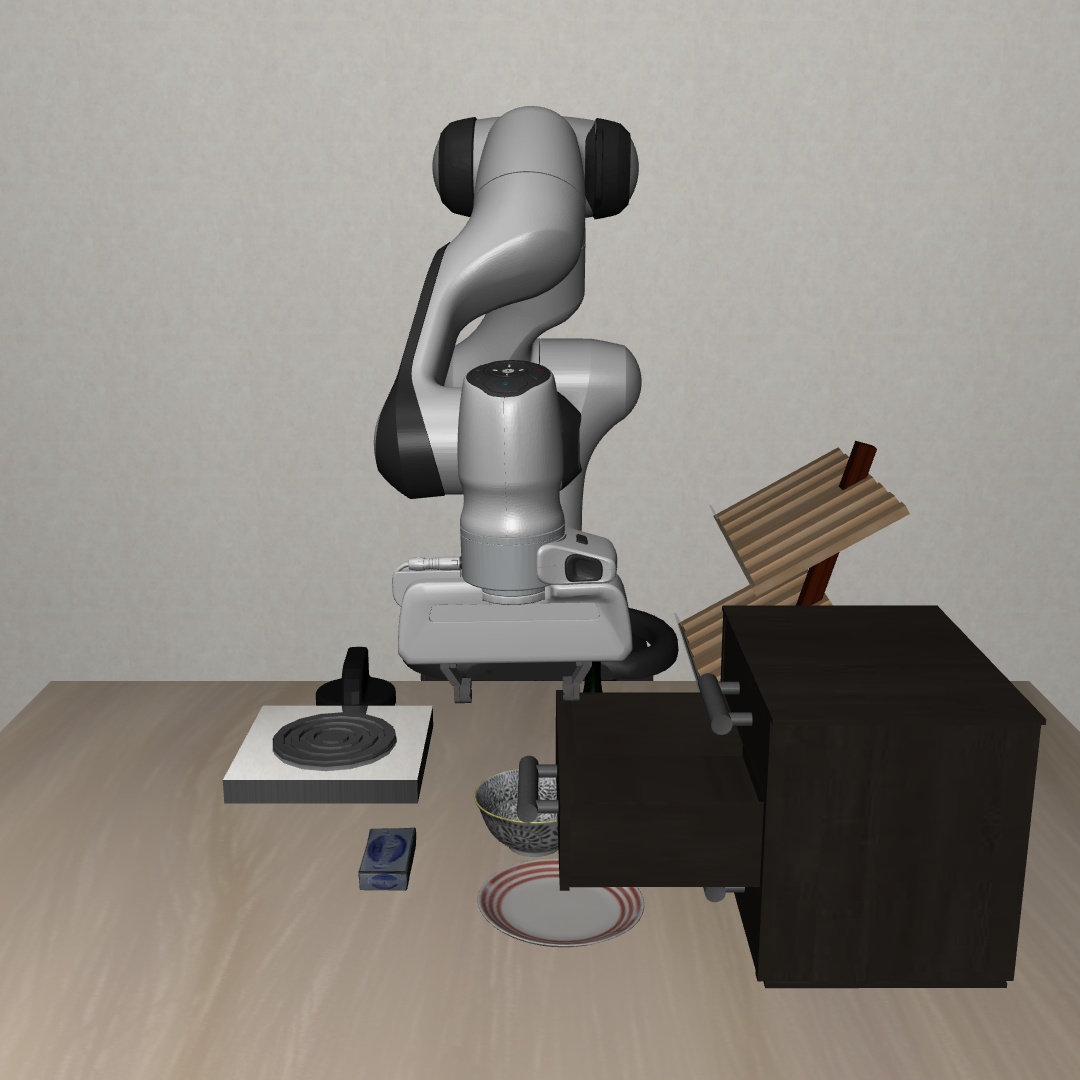
Across 640 matched handoff states (64 ordered LIBERO-Goal pairs × 10 states) on frozen π0.5, atomic skills succeed at 98.0% solo but collapse to 14.2% when chained directly. Re-homing the arm recovers pose shift (82.8%), yet leaves a stubborn 15.2-point gap. To isolate what causes that gap, we perform three matched counterfactual interventions on identical handoff snapshots.
1 · Body Reset (Home)
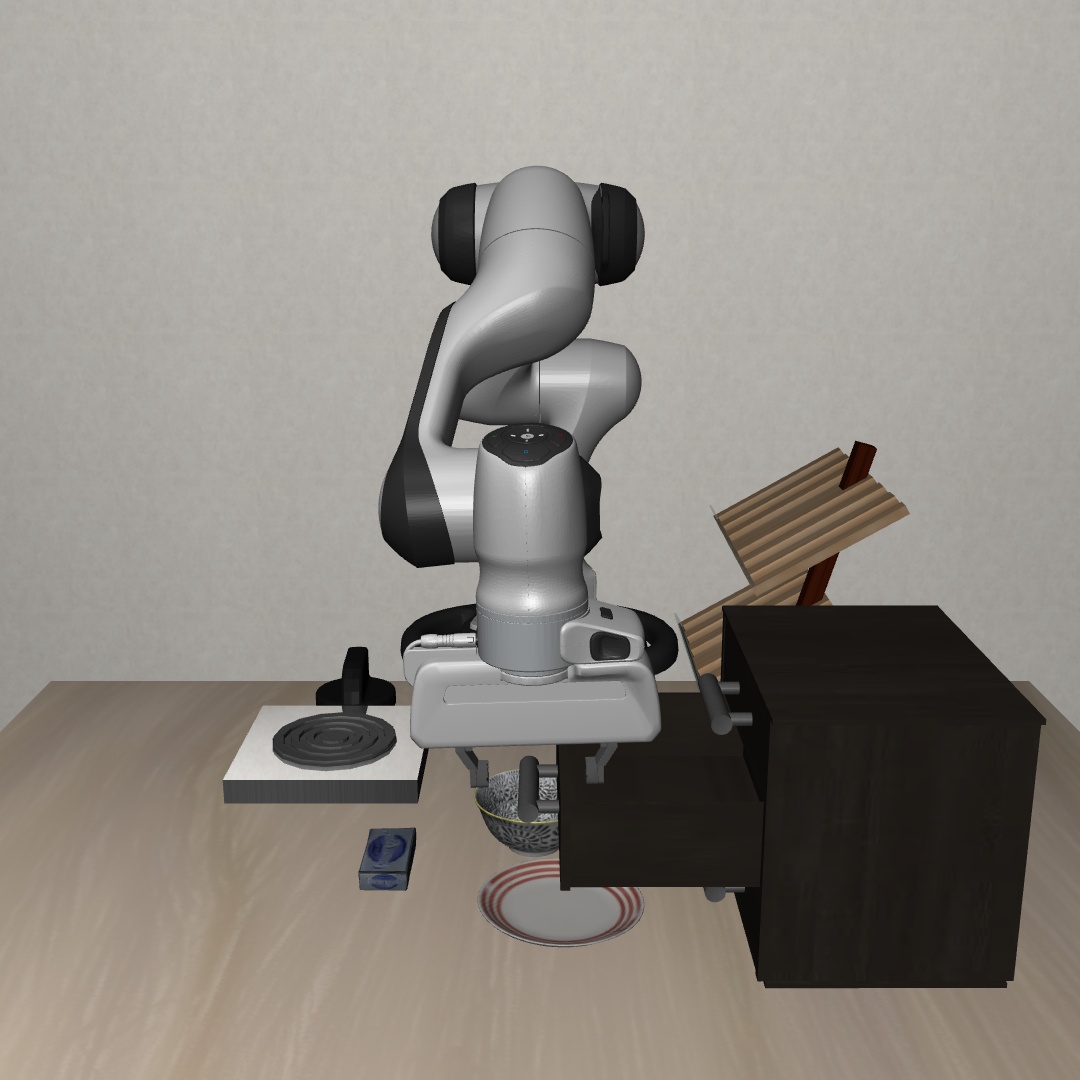 2 · View Reset (Hide Pixels)
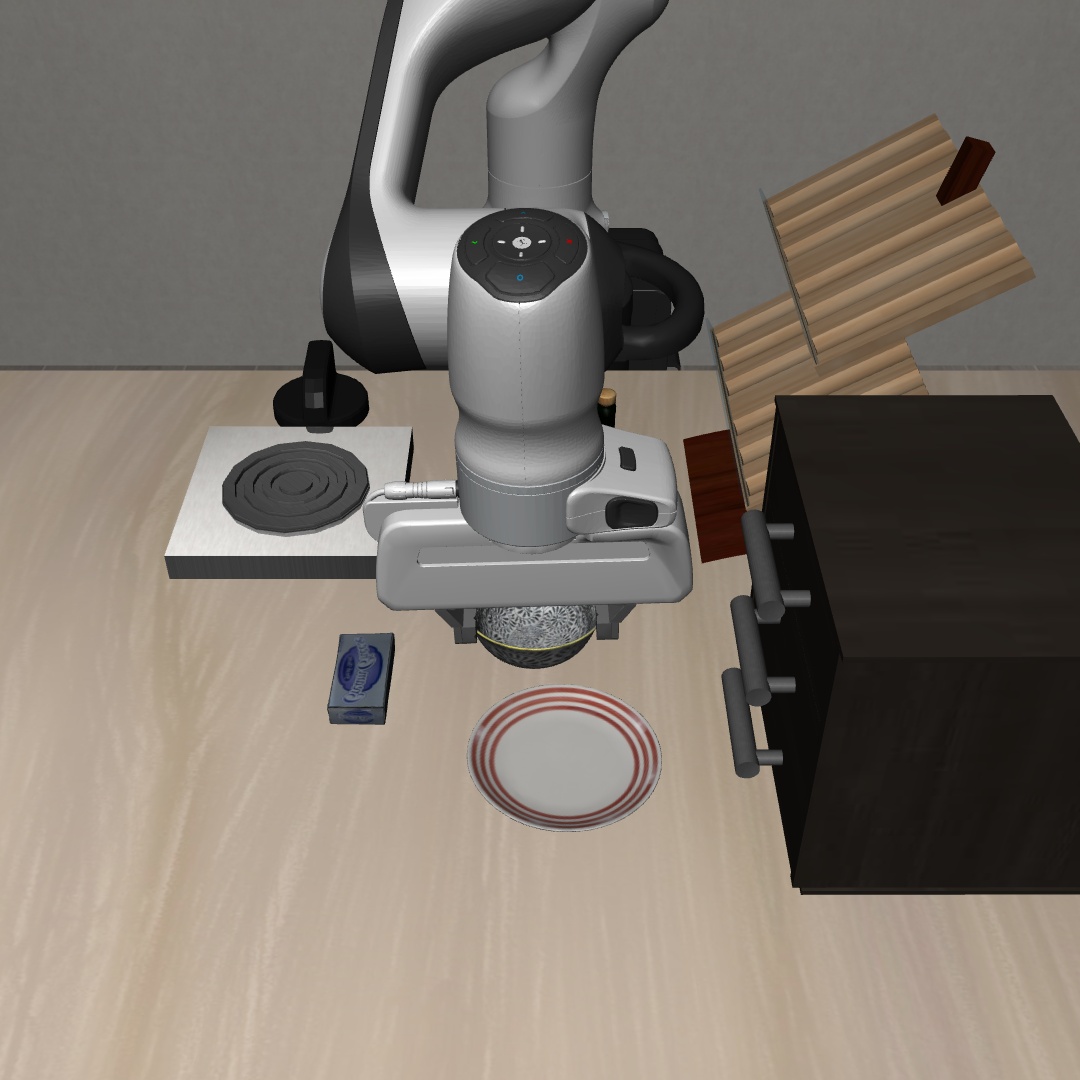 Policy Sees
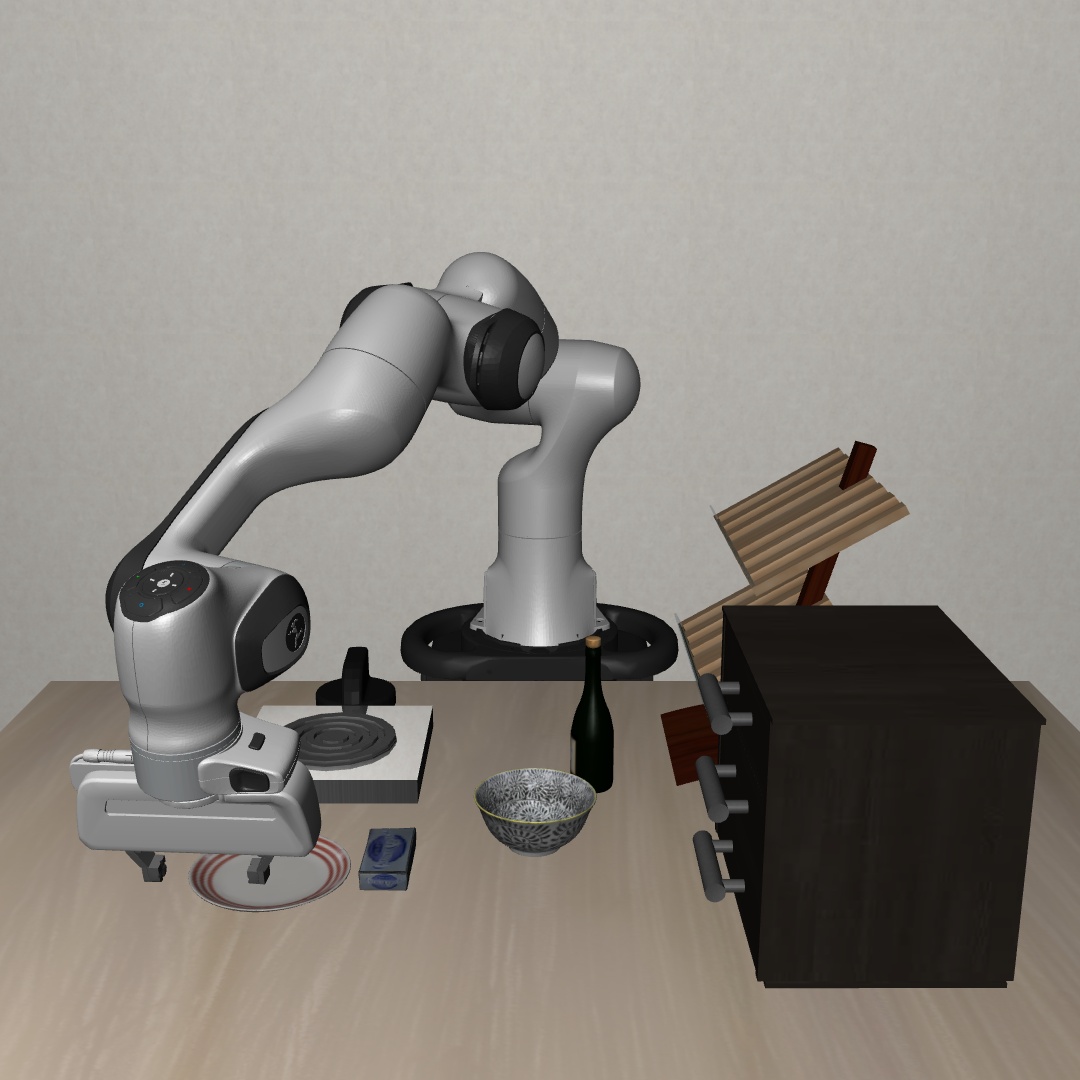 3 · World Reset (Physics)
Controlled Causal Decomposition (640 Matched Handoff States)
Post-hoc split confirms the mechanism: re-homed skills succeed 93.7% when they avoid residue (n=526), versus 32.5% when they touch it (n=114).
Policy Specificity: Same Open Middle Drawer → 9 Successor Skills
The exact same physical obstacle breaks 5 skills (0–4/10) while leaving 3 skills untouched (9–10/10).
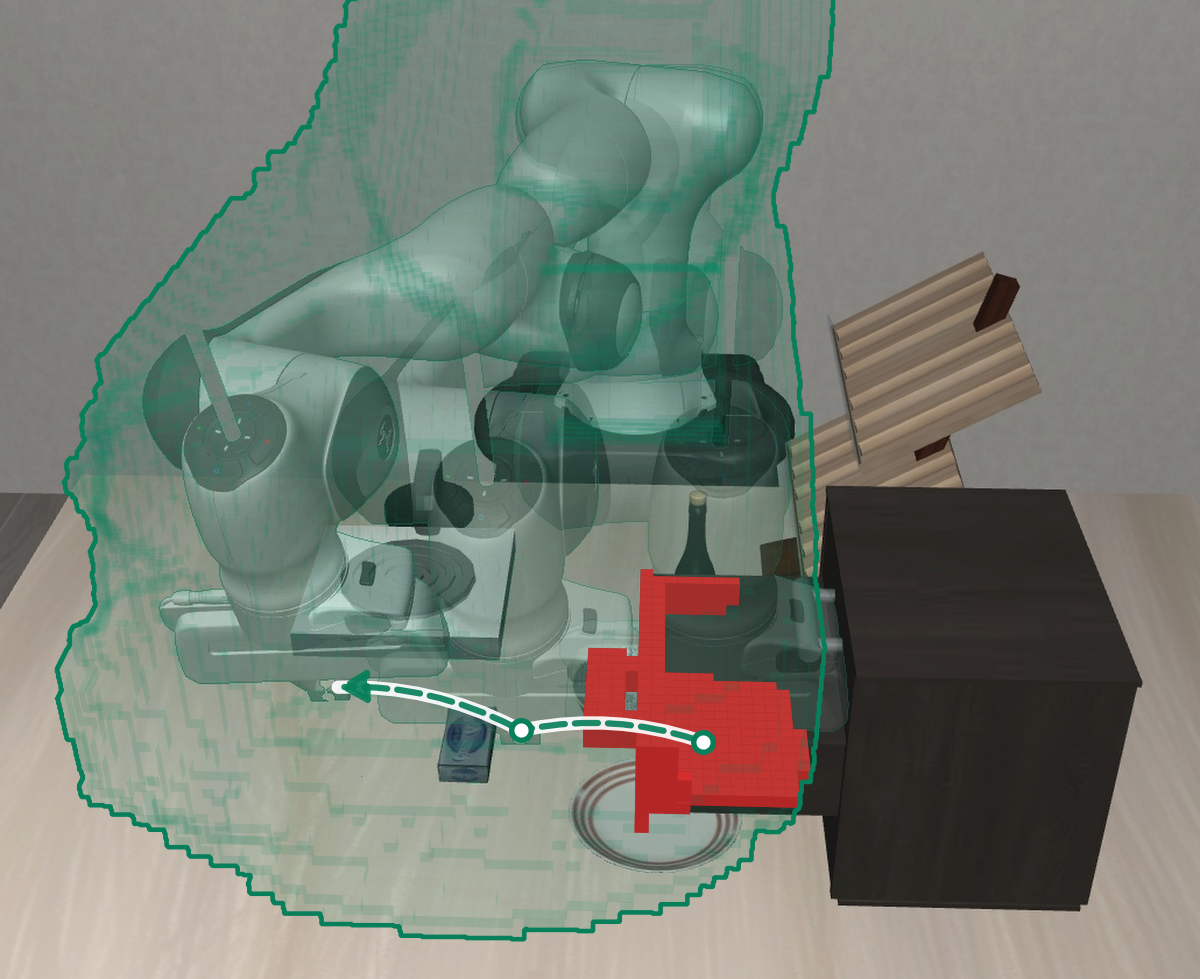 Push Plate · 0/10 (418 cm³ overlap)
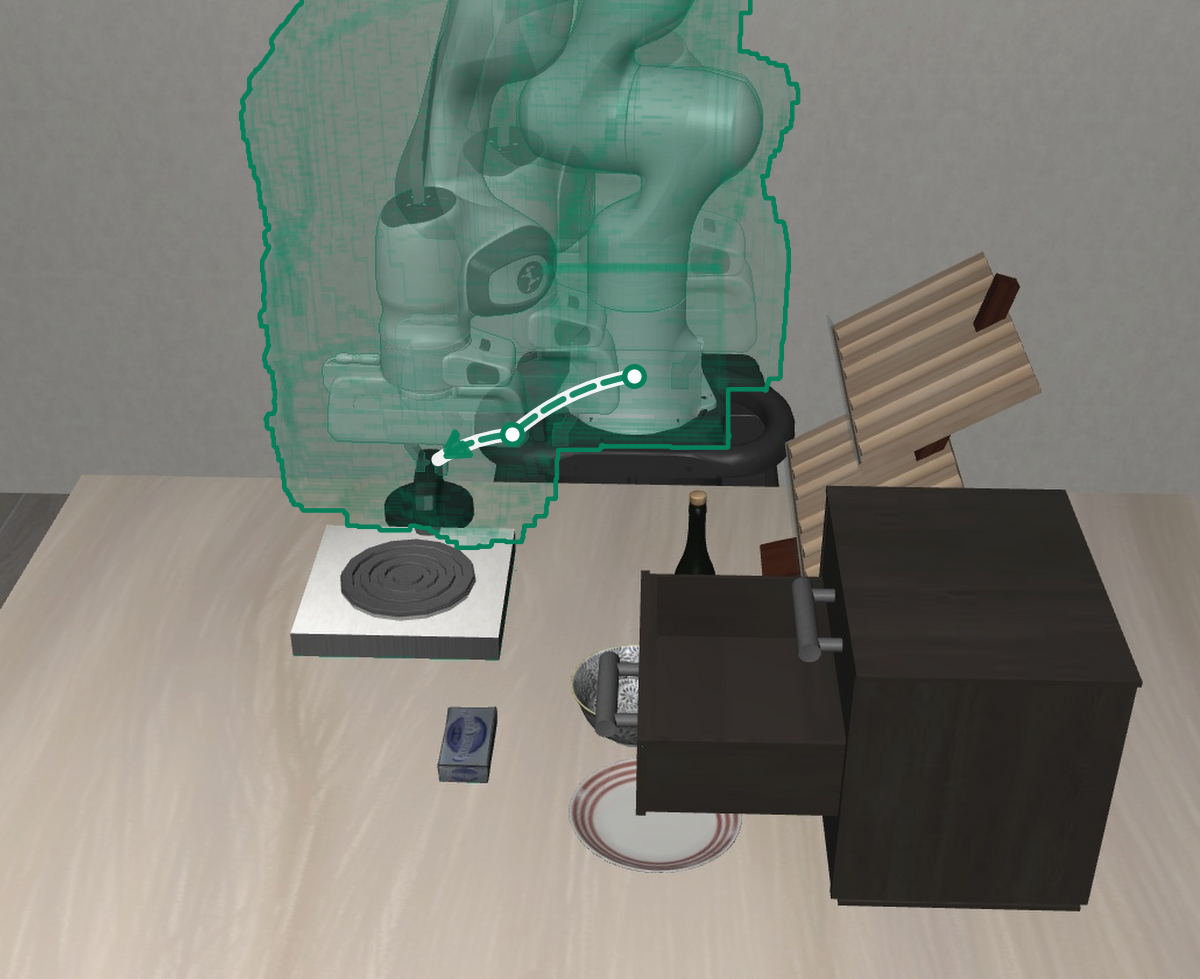 Turn on Stove · 10/10 (0 cm³ overlap)
“The very trajectory rigidity that makes a frozen VLA fragile at skill seams is what makes its 3D swept volume predictable in advance.”
Mechanism Intuition · DAgger Analogy
Why Frozen Skills Collapse: Start-State Shift & Mid-Tube Obstacles
Viewing skill execution through the lens of behavioral cloning distribution shift unifies both failure modes. Direct chaining drops skill B outside its training start support ptrain(s0), triggering DAgger-like compounding divergence (14.2%). Re-homing returns the arm to the entrance of the training manifold, yet displaced physical residue still blocks the rigid mid-rollout tube.
Part II · Method
3D Skill Envelopes: Offline Profiling, Online Gating & Classical 3D Tools
Rather than finetuning brittle policies or prompting VLMs to guess unseen robot trajectories, we profile each frozen skill's swept 3D occupancy offline in O(n) solo rollouts and expose it online via two deterministic geometric tools.
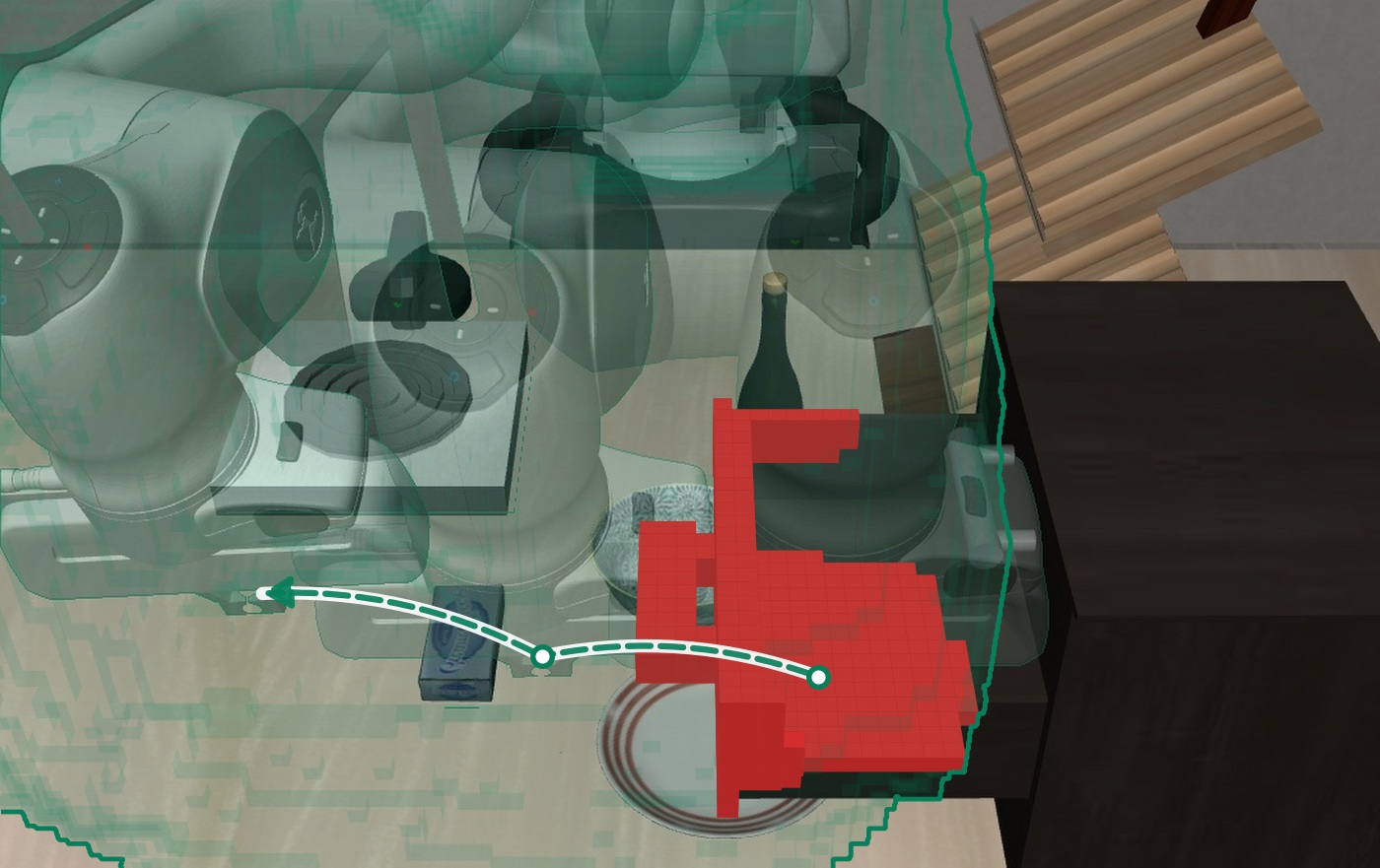 Solo rollouts → 1 cm voxel occupancy map
O(n) Offline Profiling & Detector-Free Single-View RGB-D
For each frozen skill πk, we execute N solo rollouts and project robot link meshes, gripper fingers, and held objects onto a 1 cm voxel grid via forward kinematics (FK)—requiring zero human demonstrations and zero failure data. Online, single-view depth differencing (>1 cm against the initial workspace depth) with a 2 cm inflated FK self-mask extracts displaced residue voxels Vdepth with no object detector.
 Eq. (1)
 Eq. (2)
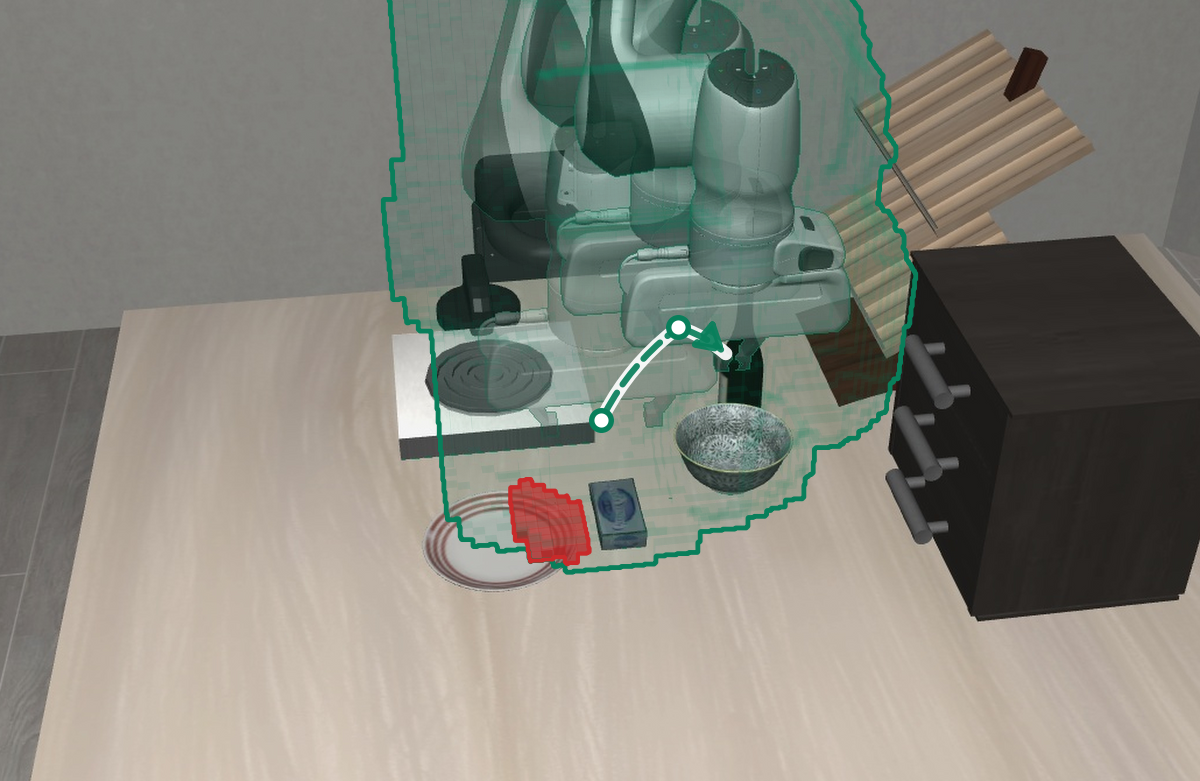 CHECK(k, s) · Collision Check & 0-Param Gating
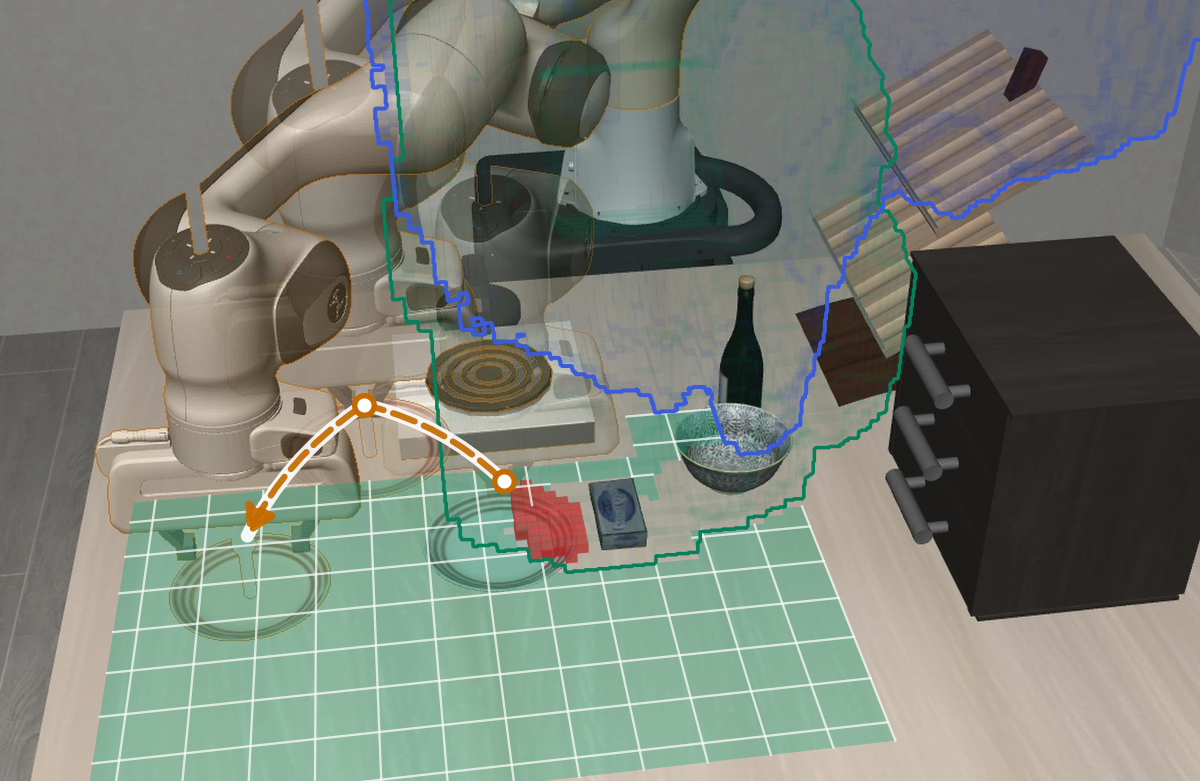 FREE(K, s) · Multi-Step Safe Placement Search
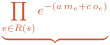
Calibrated 5-Parameter Readiness Model (Eq. 3)
Online gating uses 0-parameter CHECK alone. When continuous success probabilities are needed for multi-step ordering or VLM
AUROC evaluation, a minimal 5-parameter hazard model multiplies baseline pose readiness by per-obstacle collision survival:
Eq. (3)

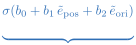

① Body Baseline (3 params: b0, b1, b2)
② Obstacle Survival Product (2 params: a, c > 0)
Try real handoffs:
pk(s) =
0.96
×
1.00
=
96%
0 cm³ overlap · e0 = 1 (zero penalty)
1 · Arm Alignment
Obstacle-free baseline
Depends only on re-homing pose error  ; accurate homing
keeps σ(·) close to 1.
2 · Survival Product
Zero overlap = zero penalty
Non-overlapping residue (me = oe = 0) yields e0 = 1; invading the envelope triggers smooth exponential decay across multiple obstacles.
3 · Why Zero-Drawer Transfers
Category-agnostic geometry
No object IDs enter the model—fitting (a, c) on tabletop items alone generalizes to unseen articulated drawers at 0.912 AUROC.
Part III · Live Execution & Recovery
Side-by-Side Execution Gallery
Unedited simulation rollouts contrasting tool-free / re-homed baselines against 3D Skill Envelope planning, FREE tabletop
clearing, and concise analytic recovery primitives across both LIBERO-Goal (π0.5) and
BOSS-44 (BC-ViT-T).
BOSS-44 · BC-ViT-T
Hinged Microwave Door: Tool-Free Agent vs. 3D Envelope Planning
Left: Tool-free agent opens the microwave first, gets trapped, closes & re-opens, and knocks the placed bowl over at 954 steps. Right: 3D Skill Envelopes order steps cleanly and finish in 348 steps on the first pass.
+34.3 pts (25.7% → 60.0%)
−38% steps
0/5 → 3/5 hinged door
LIBERO-Goal · FREE(K, s)
Tabletop Obstacle Clearing: Re-homed Only vs. FREE Safe Push
Left: Re-homing alone leaves the displaced plate inside π0.5's swept path, causing failure. Right:
FREE computes a reachable safe zone outside Ek ∪ Ek+1, pushes the plate aside,
and π0.5 succeeds immediately.
Plate: 45% → 80%
All tabletop: 94.4% (n=71)
0.5× Slow-Mo · ~30-Line Code
Prismatic Drawer Recovery: Code Primitive (98.6%) vs. VLA (0.4%)
Prompting frozen π0.5 with inverse instructions (“close the drawer”) succeeds only 1/280 (0.4%). A 30-line deterministic geometric primitive closes drawers cleanly at 138/140 (98.6%).
98.6% vs. 0.4%
Zero VLA finetuning
BOSS-44 · Revolute Door Code
Articulated Hinged Door Recovery Primitive
Beyond sliding drawers, a compact two-stage revolute closing primitive recovers swinging microwave doors whenever
CHECK detects overlap with an upcoming BC-ViT-T skill.
Repairs −92.2% (51 → 4)
VLM calls −87.8% (49 → 6)
Part IV · Quantitative Evaluation
Experiments & Benchmarks (RQ1–RQ5)
Hover any bar or data point for detailed statistics. Across five research questions, 3D Skill Envelopes match privileged simulation truth from a single depth camera, beat frontier VLMs on seam prediction, unify dual LLM backends at the same ceiling, cut live wall-clock latency by 5.60×, and transfer across benchmarks and policy architectures.
Single-View RGB-D Matches Sim Truth (0.944) & Transfers Zero-Drawer
RQ1 · Detection & Generalization0-Parameter 3D Overlap Detection & 5-Parameter Readiness Cross-Category AUROC
140 / 140
Exact gating agreement between single-view RGB-D and privileged sim (426 ms)
0.944 vs 0.946
Zero-shot RGB-D overlap AUROC trails sim truth by only 0.002, detector-free
0.912 vs 0.681
Zero-drawer training generalizes to open drawers; no-geometry drops to 0.499
Why Frontier VLMs Miss Seams: They Cannot See Dynamic 3D Arm Sweeps
RQ2(a) · vs. Frontier VLMs429 Test Handoffs: 3 VLM Backends × 3 Prompt Styles
Same Open Middle Drawer → 9 Successors (Qwen4-Max Flags Almost All 7/7)
VLAs Cannot Repair OOD Seams (0.4%); Proactive Code & FREE Recover
RQ2(b) · Code Recovery & FREEInverse VLA Prompting vs. Reactive Repair vs. Proactive 3D Code Recovery & FREE Clearing
Dual LLMs Converge to 91.4%; Live Single-View RGB-D Gating Delivers 5.60× Speedup
RQ3 & RQ4 · Multi-Step & Latency128 Drawer-Bearing 3–4 Step LIBERO-Goal Chains
Live Single-View RGB-D Wall-Clock Breakdown (Matched n = 88)
656 / 656
Online single-view RGB-D gating agrees 100% with privileged state across live chains (93.8% success)
87.8% skipped
Clean seams bypass LLM/VLM straight to frozen VLA (0.0 VLM calls; 88/88 chains faster)
0 → 28 / 32
Two-drawer conflict chains jump from 0/32 to 28/32 with zero chain-end redos (vs. 27 for tool-free LLM)
Beyond VLAs & Drawers: BOSS-44 (BC-ViT-T + Hinged Microwave) Gains +34.3 pts
RQ5 · Cross-Benchmark & Cross-PolicyBOSS-44 Held-Out Test Suite (35 Multi-Step Chains · Non-VLA BC-ViT-T)
Universal Property of Frozen Visuomotor Policies
Replacing π0.5 with an independent Transformer behavioral-cloning policy (BC-ViT-T) on a distinct kitchen
benchmark with articulated hinged microwave doors yields the exact same compositional pattern: 3D Skill Envelopes lift completion
from 25.7% (9/35) to 60.0% (21/35) (p = 0.0075), cutting mid-chain repairs by
92.2%, VLM calls by 87.8%, execution steps by 38.0%, and chain-end redos from
18 → 0.
Part V · Limitations & Roadmap
Stage-2 Open Scientific Questions
Three targeted open questions test the remaining physical, scaling, and autonomy assumptions of policy-measured 3D preconditions.
Q1 · PHYSICAL HARDWARE
Real-Robot Online RGB-D Loop
Deploy the single-view RGB-D gating loop on a dual-arm PiPER + Pika + RealSense tabletop cell to test robustness under specular depth holes, calibration drift, and compliant physical contacts.
Q2 · SCALE & CROSS-VLA
High-Clutter Saturation & OpenVLA-OFT
Scale to 6–10 step cluttered scenes (BEHAVIOR-1K & BOSS CH3) to characterize free-space saturation of ⋃j Ej, and test 2×2 cross-policy envelope specificity with OpenVLA-OFT.
Q3 · AUTONOMOUS RECOVERY
Envelope-Verified Code Synthesis
Use CHECK and FREE as geometric safety verifiers for LLM-synthesized recovery primitives on unseen
articulated and stacked obstacles, distilling verified fixes into a reusable library.
Citation
BibTeX
If you find 3D Skill Envelopes or our controlled seam-attribution findings useful in your research, please cite:
@article{zhang2026skillenvelope,
  title={VLAs Execute, Code Recovers: 3D Skill Envelopes Bridge the Compositional Gap in Agentic Manipulation},
  author={Zhang, Jiajie and Xiang, Yankai and Chen, Changhao},
  journal={arXiv preprint arXiv:2611.32245},
  year={2026}
}